


Few franchises in the world of video games carry the same weight, legacy, and cultural impact as The Legend of Zelda. Since its debut in 1986, Nintendo’s legendary action-adventure series has grown into one of the most iconic and beloved sagas in gaming history. What began as a modest experiment by Shigeru Miyamoto and Takashi Tezuka has evolved into a sprawling franchise that has defined entire generations of players, inspired countless game developers, and shaped the action-adventure genre itself. In this long-form analysis, we will take an in-depth look at The Legend of Zelda, examining its origins, gameplay innovations, narrative evolution, and the lasting legacy it has cemented across nearly four decades.
The Birth of a Legend
When Nintendo released The Legend of Zelda for the Famicom Disk System in Japan in 1986, few could have predicted the monumental success it would become. Developed under the guidance of Shigeru Miyamoto, the game was born out of his childhood experiences exploring forests, caves, and lakes around his hometown. He wanted to capture that sense of curiosity, discovery, and adventure. What resulted was a revolutionary title that allowed players to explore an open world in a non-linear fashion—a rarity at the time.
Unlike most games of the era, which guided players through fixed stages, The Legend of Zelda encouraged freedom. It dropped players into the vast kingdom of Hyrule with little direction, urging them to explore, experiment, and uncover secrets on their own. The concept of saving progress using battery backup was also groundbreaking, paving the way for longer and more complex adventures.
Defining the Core Gameplay
At its heart, The Legend of Zelda is built on a simple but compelling loop: exploration, combat, puzzle-solving, and progression. Over the years, Nintendo has refined and expanded this loop, but the fundamentals remain intact.
Exploration
Exploration is the soul of Zelda. From the original game’s open Hyrule field to the vast expanses of Breath of the Wild, players are constantly encouraged to wander, experiment, and discover hidden treasures, dungeons, and secrets.
Combat
Link, the silent protagonist, relies on his iconic sword and shield, but the series has always expanded the arsenal with boomerangs, bows, bombs, hookshots, and more. Combat often blends strategy and timing, requiring players to adapt based on enemies and environments.
Puzzle-Solving
Dungeons, a staple of the series, are filled with puzzles that challenge logic, spatial awareness, and creativity. These puzzles often serve as gatekeepers to powerful new items that redefine how players interact with the world.
Progression
The reward loop is one of the strongest aspects of Zelda. As players unlock new items, they gain access to previously unreachable areas, creating a satisfying cycle of discovery and empowerment.
The Story of Hyrule
Though gameplay often takes center stage, The Legend of Zelda has crafted a rich mythos that blends fantasy, mythology, and timeless themes of courage, wisdom, and power.
Link: The Eternal Hero
Link is not a single character but rather a recurring hero reincarnated across different eras of Hyrule. His defining traits—courage, humility, and determination—make him the perfect vessel for players to inhabit.
Zelda: The Princess of Wisdom
Princess Zelda is far more than a damsel in distress. Over the series, she has evolved into a powerful figure—sometimes a sage, sometimes a warrior, sometimes even a pirate captain (as in The Wind Waker). Her wisdom balances Link’s courage.
Ganon/Ganondorf: The Embodiment of Power
The primary antagonist, Ganon, represents greed, corruption, and the destructive potential of unchecked power. His recurring battles with Link and Zelda embody the eternal conflict of the Triforce.
The Triforce
At the core of the lore is the Triforce, a sacred relic divided into three pieces: Power, Wisdom, and Courage. It symbolizes balance, but when corrupted, it becomes a source of great conflict.
Evolution Across Generations
Over nearly four decades, The Legend of Zelda has continually reinvented itself while remaining true to its roots.
The NES Era
- The Legend of Zelda (1986): Introduced open-world exploration and non-linear gameplay.
- Zelda II: The Adventure of Link (1987): Took a bold departure with side-scrolling action and RPG elements.
The SNES Era
- A Link to the Past (1991): Returned to top-down exploration, adding parallel worlds and deeper narrative complexity. Widely regarded as one of the greatest games of all time.
The N64 Revolution
- Ocarina of Time (1998): A landmark title that set the standard for 3D action-adventure games. Its innovations in targeting, cinematic storytelling, and dungeon design remain influential.
- Majora’s Mask (2000): Built on Ocarina’s engine but introduced a darker, time-based mechanic, earning cult classic status.
GameCube and Beyond
- The Wind Waker (2002): Controversial at launch due to its cel-shaded art style, but later celebrated for its charm and oceanic exploration.
- Twilight Princess (2006): A darker, more mature take that balanced nostalgia with innovation.
- Skyward Sword (2011): Focused heavily on motion controls and provided the origin story of the Master Sword.
The Open-World Reinvention
- Breath of the Wild (2017): Completely redefined the franchise, emphasizing open-world freedom, physics-based gameplay, and minimal hand-holding. Widely considered one of the best games ever made.
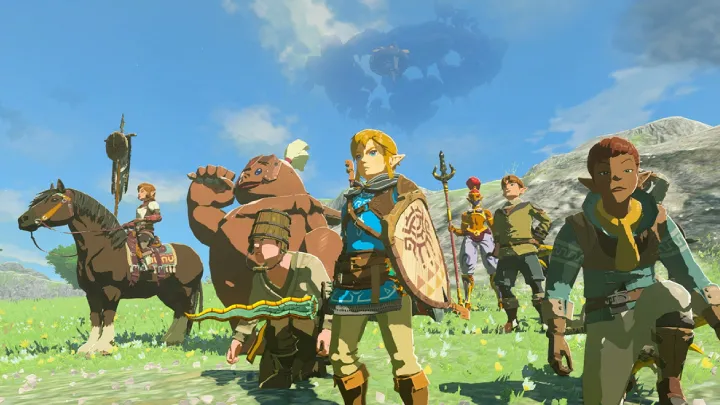
- Tears of the Kingdom (2023): Expanded upon Breath of the Wild with new mechanics like building, fusing, and vertical exploration across skies and depths.
Music and Atmosphere
Koji Kondo’s music for The Legend of Zelda has become as iconic as the gameplay itself. From the adventurous overworld theme to the haunting melodies of dungeons, the music enhances every moment. Later entries introduced orchestral scores, adding cinematic weight to the experience. The series has also excelled in atmospheric design—whether it’s the mysterious woods, stormy seas, or volcanic mountains, Zelda’s environments feel alive.
Thematic Analysis
Beneath its gameplay, The Legend of Zelda is a story about timeless themes.
- Courage vs. Fear: Link’s journey embodies courage in the face of overwhelming odds.
- The Cycle of Good and Evil: The recurring battle between Link, Zelda, and Ganon reflects the eternal struggle of balance.
- Growth and Discovery: Each game mirrors the player’s personal journey of learning, failing, and ultimately mastering challenges.
Cultural Impact
The influence of The Legend of Zelda cannot be overstated.
- Industry Influence: Many modern open-world games—from Skyrim to Elden Ring—owe design inspiration to Zelda.
- Speedrunning Community: Zelda games are a cornerstone of speedrunning culture, with players constantly finding new strategies to complete them faster.
- Pop Culture: References to the Master Sword, Triforce, and Link permeate movies, television, and music.
- Fandom: The series has cultivated a devoted fanbase, inspiring art, music covers, cosplay, and fan theories that keep the lore alive.
Criticism and Challenges
No franchise is without its missteps. Zelda II was divisive due to its difficulty. Skyward Sword drew criticism for its linearity and motion-control reliance. Even Breath of the Wild, despite acclaim, sparked debate over weapon durability and sparse story delivery. Yet these criticisms reflect a franchise willing to experiment, evolve, and take risks.
The Future of Zelda
Where does Zelda go from here? Tears of the Kingdom has set a new bar for open-world design, but expectations are sky-high. Nintendo may explore:
- More nonlinear storytelling.
- A return to darker tones akin to Majora’s Mask or Twilight Princess.
- Potential multiplayer or co-op elements.
- A deeper look into the Zelda timeline and lore.
Whatever the direction, one thing is certain: The Legend of Zelda will continue to innovate while honoring its core values of adventure, discovery, and courage.
Conclusion
The Legend of Zelda is more than just a video game series—it is a cultural phenomenon that has shaped the medium itself. From its humble beginnings in 1986 to the expansive open worlds of today, it has continually pushed boundaries while remaining true to the spirit of adventure. It has given players unforgettable journeys, timeless music, and stories that resonate across generations. Whether you’re a lifelong fan or a newcomer setting foot in Hyrule for the first time, Zelda remains a timeless journey worth taking.