





In today’s hyperconnected world, communication across languages has become an essential part of both professional and personal life. By 2025, AI-driven language and translation apps have evolved into powerful tools that go beyond basic word-for-word translation. They now deliver context-aware, real-time, and culturally adaptive communication.
From business negotiations and international travel to academic research and personal interactions, these apps are bridging language barriers faster than ever. What once required human interpreters can now be achieved instantly through AI models powered by natural language processing (NLP), machine learning, and contextual reasoning.
This article explores the Top 5 AI Language & Translation Apps in 2025, their latest features, and how they are changing the way we communicate across borders.
1. Google Translate Neo: Real-Time Global Communication
Google Translate has been a staple for years, but in 2025, it has evolved into Google Translate Neo, a fully AI-integrated communication platform.
Instead of providing literal translations, Google Translate Neo now employs contextual understanding and cultural adaptation. For example, idiomatic expressions like “break the ice” or “spill the beans” are translated into locally relevant equivalents, making conversations more natural.
Key Features of Google Translate Neo
- Real-time voice-to-voice conversations across 150+ languages.
- AR-powered translation of signs, menus, and documents via smartphone camera.
- Offline AI models, enabling high-quality translation without internet connectivity.
This makes Google Translate Neo the go-to app for travelers, students, and professionals engaging in cross-border collaboration.
2. DeepL Horizon: The Precision Specialist
DeepL has gained popularity for its accuracy, and by 2025, its latest version—DeepL Horizon—has taken precision to new heights. Unlike other translation apps that prioritize speed, DeepL Horizon is designed for academic, business, and legal translations, where accuracy and nuance are critical.
The app leverages large-scale neural networks trained on domain-specific datasets, ensuring that legal documents, medical records, or scientific research papers maintain accuracy in meaning and terminology.
Why DeepL Horizon Stands Out
- Context-sensitive translations for specialized industries.
- Integration with Microsoft Office, Google Docs, and Slack for seamless workflows.
- Team collaboration tools, allowing organizations to manage multilingual projects.
DeepL Horizon is favored by law firms, researchers, and multinational corporations who cannot afford errors in translation.
3. Microsoft Copilot Translate: Enterprise-First Solution
Microsoft has embedded AI translation deeply within its ecosystem, and in 2025, Copilot Translate emerges as the leading enterprise-focused AI translator.
Seamlessly integrated into Microsoft Teams, Outlook, and Office 365, Copilot Translate ensures that international teams can collaborate without communication barriers. During live meetings, the app provides instant subtitles in multiple languages simultaneously, making global teamwork smoother than ever.
Features of Microsoft Copilot Translate
- Live multilingual transcription and subtitles in Teams.
- Context-aware email translation directly in Outlook.
- Security-first design for industries like finance and healthcare.
Its enterprise-grade security ensures that sensitive communications remain private—a crucial factor for global corporations.
4. iTranslate ProX: Everyday Language Companion
iTranslate, one of the pioneers in mobile translation, has introduced iTranslate ProX in 2025. This version focuses on everyday use, catering to travelers, students, and casual users who need fast, friendly, and conversational translation.
The app offers phrasebook learning integration, helping users not only translate but also learn the language through repetition and gamified exercises. Its AR lens allows real-time translation of objects, menus, and even handwritten notes.
Highlights of iTranslate ProX
- Voice recognition with natural fluency for smoother conversations.
- Travel assistant mode with instant translations of signs, transportation, and directions.
- Gamified learning tools, turning translation into a fun language-learning journey.
This makes iTranslate ProX the perfect hybrid of translation and learning app for casual users.
5. Lingua AI: The Next-Generation Multimodal Translator
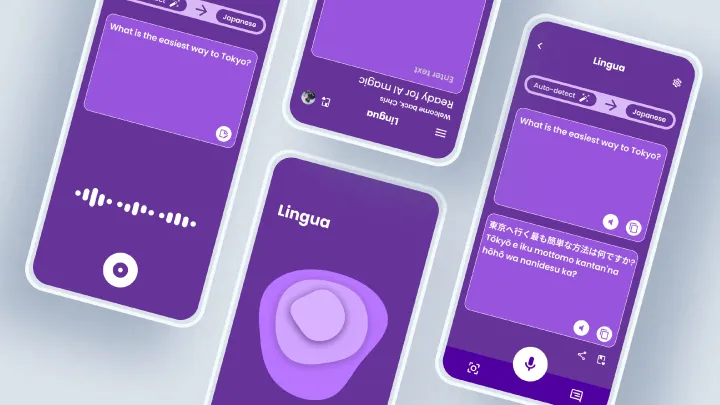
The newest entry on the list, Lingua AI, has made waves in 2025 as a multimodal translation powerhouse. Unlike other apps that focus mainly on text and speech, Lingua AI integrates speech, images, video, and even gestures for holistic communication.
For example, during video calls, Lingua AI can translate spoken words while adjusting lip-sync so the speaker appears to be speaking in the listener’s native language. It also translates body language and cultural gestures, offering an unparalleled communication experience.
Unique Features of Lingua AI
- Lip-synced multilingual video calls.
- Gesture and cultural context translation.
- Cross-app integration with WhatsApp, Zoom, and social media platforms.
Lingua AI represents the future of translation, where communication transcends text and sound, moving into truly human-like interactions.
6. The Rise of AI Translation in 2025
The common theme across these apps is contextual intelligence. Unlike early translators that provided literal outputs, 2025’s apps understand tone, slang, and cultural nuances, making communication more authentic.
This is critical in business deals, academic research, and international diplomacy, where miscommunication can lead to major consequences.
7. The Role of AR & VR in Language Apps
Augmented reality (AR) and virtual reality (VR) are now deeply integrated into translation tools. Users can wear AR glasses to see translated captions in real time, or participate in VR meetings where language barriers no longer exist.
This is particularly revolutionary in tourism and education, where immersive experiences make learning and communicating natural.
8. AI Translation for Businesses and Enterprises
Enterprises have adopted AI translation apps as a standard tool. Global companies are saving billions in interpretation costs by using real-time AI solutions.
Whether it’s negotiating contracts, conducting cross-border training, or managing global supply chains, these apps ensure fluid communication across languages.
9. AI Translation and Accessibility
Beyond businesses and travel, these apps are transforming accessibility. People with hearing impairments can use them for instant captioning, while migrants and refugees rely on them for integration into new communities.
By 2025, translation apps are not just convenience tools but essential inclusivity technologies.
10. The Future of Language & Translation Beyond 2025
Looking ahead, translation apps will become invisible companions, integrated into smart glasses, cars, and even brain-computer interfaces. Imagine walking into a foreign country and hearing every conversation in your own language instantly.
The future will see AI bridging not just language, but cultures, traditions, and human experiences, creating a truly borderless world.
Conclusion: Breaking Barriers, Building Bridges
The Top 5 AI Language & Translation Apps in 2025—Google Translate Neo, DeepL Horizon, Microsoft Copilot Translate, iTranslate ProX, and Lingua AI—are revolutionizing communication.
They go beyond literal translation to provide contextual, cultural, and even emotional accuracy, making interactions feel natural and authentic.
In a world that grows more interconnected by the day, these apps represent more than technology—they are bridges of understanding, bringing humanity closer together.