







In the digital age, navigation apps have become an essential part of our daily lives. Whether you are commuting to work, planning a road trip, or simply exploring new cities, the right navigation app can save you time, reduce stress, and provide peace of mind. The market in 2025 is filled with powerful contenders, each offering unique features, user-friendly designs, and advanced technologies like artificial intelligence and augmented reality. This article explores the Top 5 Apps for Navigation and Maps in 2025, analyzing their strengths, weaknesses, and overall value to help you decide which one fits your lifestyle best.
1. Google Maps
Google Maps continues to dominate the navigation space as the most widely used app worldwide. Its comprehensive coverage and seamless integration with Google’s ecosystem make it the go-to choice for millions of users. In 2025, the app has grown far beyond simple turn-by-turn directions, becoming a platform that integrates travel, discovery, and local recommendations.
Key Features
Google Maps provides real-time traffic updates, detailed transit schedules, and walking and cycling routes. The app’s AI-driven predictive analysis can anticipate traffic congestion before it happens, rerouting drivers dynamically. One of its most celebrated features is Street View, allowing users to visually explore neighborhoods before arriving. Additionally, its integration with Google Search and Google Business Listings makes it a tool not just for navigation, but also for discovering restaurants, shops, and attractions.
Strengths
The strength of Google Maps lies in its global reach. Whether you are in New York, Tokyo, or a rural town in South America, chances are that Google Maps will have detailed coverage. Its accuracy in estimating arrival times and its user-friendly interface add to its popularity. The app is also constantly updated by both Google and its massive user community, ensuring reliability.
Weaknesses
Despite its strengths, Google Maps can sometimes feel cluttered with too much information. Ads and promoted locations can distract from the core navigation experience. Privacy concerns also exist, as Google collects significant amounts of user data. Some users find this invasive, although the benefits often outweigh the drawbacks.
Rating
Overall, Google Maps scores a solid 9.5/10 for its unmatched coverage, accuracy, and features.
2. Waze
Waze, owned by Google, takes a community-driven approach to navigation. It has built its reputation on real-time, crowd-sourced updates that make it especially useful for drivers in urban environments.
Key Features
Waze specializes in providing live traffic updates, road hazards, and speed trap alerts—all reported by fellow drivers. The app also includes carpooling options and voice-guided navigation. In 2025, Waze has expanded its functionality with predictive traffic patterns and integration with smart vehicles, allowing drivers to avoid congestion more effectively than ever.
Strengths
The biggest advantage of Waze is its ability to keep drivers informed in real time. By relying on its massive community of users, Waze offers an unparalleled level of detail about road conditions. For example, users are notified instantly about accidents, road closures, or even police checkpoints. This makes it extremely useful for commuters in busy cities.
Weaknesses
However, Waze is not perfect. Because it focuses heavily on driving, it lacks robust features for walking, cycling, or public transport. Some users also complain that the app sometimes reroutes them through smaller residential streets, which may not always be convenient or safe. The interface, while fun and engaging, can feel overwhelming compared to the simplicity of Google Maps.
Rating
Waze earns a 9/10, excelling in live driving assistance but falling short in multi-modal transportation options.
3. Apple Maps
Apple Maps has come a long way since its shaky debut years ago. In 2025, it is considered one of the most polished and secure navigation apps available, particularly for iPhone users.
Key Features
Apple Maps offers stunning 3D city views, detailed walking routes, and integration with Apple’s ecosystem, including Siri and Apple Watch. The app also includes improved transit directions, indoor mapping for malls and airports, and AR walking directions that overlay arrows and directions directly onto the real world through your iPhone’s camera.
Strengths
One of the greatest strengths of Apple Maps is its design. The app’s clean interface, intuitive controls, and visually appealing maps provide a smooth user experience. Privacy is also a major selling point—Apple emphasizes minimal data collection compared to competitors like Google. For Apple users, the seamless integration across devices makes it even more powerful, especially with features like Handoff and CarPlay.
Weaknesses
The downside is its limited global coverage. While Apple Maps is excellent in the U.S., Europe, and major Asian cities, it is still not as reliable in rural or less-developed regions. Additionally, many features are optimized for iOS users, making it less attractive for Android users.
Rating
Apple Maps deserves a 8.8/10 for its elegant design and privacy-first approach, though it still lags in worldwide coverage.

4. HERE WeGo
HERE WeGo is a strong alternative to mainstream apps, particularly popular among users who value offline navigation. Originally developed by Nokia, HERE WeGo has carved a niche for itself by providing high-quality maps and directions even without an internet connection.
Key Features
The app allows users to download entire country maps for offline use, which is perfect for travelers in areas with limited connectivity. It also supports driving, walking, cycling, and public transport directions. In 2025, HERE WeGo has added integration with ride-hailing services and improved voice guidance.
Strengths
The offline functionality is HERE WeGo’s most significant strength. Unlike Google Maps, which often requires at least intermittent connectivity, HERE WeGo works seamlessly without data, making it an ideal travel companion. Its clean design and reliable maps are also appreciated by users who want a straightforward experience without too many extras.
Weaknesses
Despite its benefits, HERE WeGo lacks some of the advanced features of competitors. Real-time traffic updates are not always as accurate, and the app’s database of businesses and points of interest is less comprehensive compared to Google Maps. It is also less popular, meaning fewer user-generated updates.
Rating
HERE WeGo earns a 8.5/10, shining in offline use but limited by weaker real-time features.
5. Sygic
Sygic is a premium navigation app that offers advanced features tailored for drivers who demand more than the basics. It is especially popular among professional drivers and frequent travelers.
Key Features
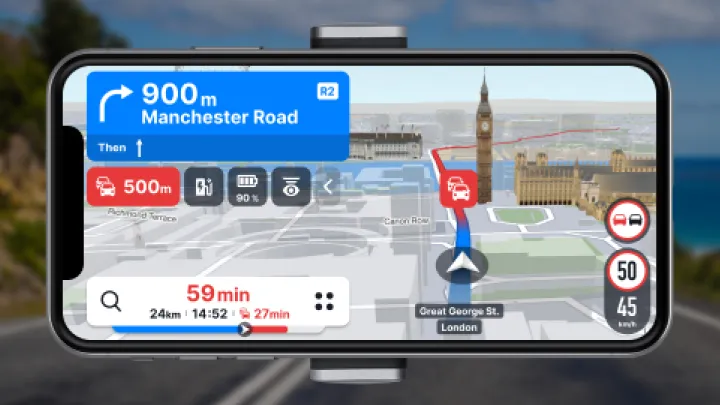
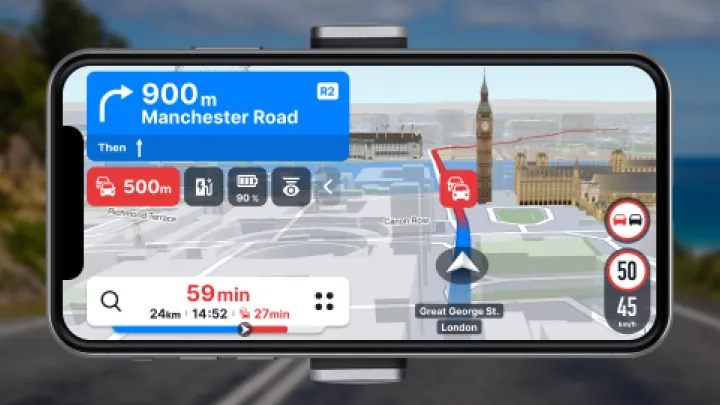
Sygic provides high-quality offline maps, advanced lane guidance, speed limit warnings, and even dashcam functionality. Its integration with Android Auto and CarPlay makes it versatile for various vehicles. In 2025, Sygic has introduced AI-driven trip planning, helping users optimize routes for fuel efficiency and travel time.
Strengths
The biggest advantage of Sygic is its professional-level features. For drivers who want more than just directions, Sygic offers tools that make driving safer and more efficient. Its offline maps are powered by TomTom, ensuring high accuracy. The app’s focus on driver safety, with features like head-up display (HUD) mode, makes it stand out.
Weaknesses
The downside is that many of Sygic’s best features are locked behind a paywall. While the free version offers basic navigation, users need to purchase premium packages for advanced tools. This can deter casual users who don’t want to spend money when free alternatives like Google Maps are available.
Rating
Sygic scores a 8.7/10 for its robust premium features, though its cost may limit its appeal.
Comparison and Final Thoughts
When comparing the Top 5 Apps for Navigation and Maps in 2025, it becomes clear that each one caters to a slightly different audience. Google Maps remains the all-around champion with its global coverage and rich feature set. Waze shines for drivers who need real-time updates and community-driven insights. Apple Maps offers an elegant, privacy-focused experience, especially for iOS users. HERE WeGo is unbeatable for offline navigation, while Sygic provides advanced tools for professional drivers.
Choosing the right app depends on your priorities. If you want an all-purpose tool, Google Maps is still the best choice. For heavy city drivers, Waze is indispensable. Travelers heading to remote areas will benefit most from HERE WeGo, while Apple loyalists will find Apple Maps hard to beat. For those who are willing to pay for premium features, Sygic delivers a powerful package.
Conclusion
Navigation apps in 2025 are smarter, faster, and more versatile than ever before. From real-time traffic insights to augmented reality directions, these apps go far beyond simple maps. The Top 5 Apps for Navigation and Maps in 2025—Google Maps, Waze, Apple Maps, HERE WeGo, and Sygic—each bring something unique to the table. Ultimately, the best choice depends on your personal needs, whether that’s global coverage, privacy, offline usability, or premium driving features. No matter which you choose, these apps ensure that you’ll never feel lost again.